


Imran Khan
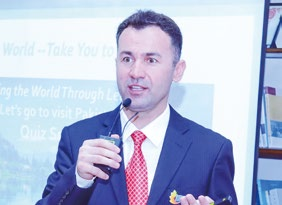
A Pakistani student who is studying in the MBA program of BRS at BNU
Background
I came from the high mountain society of Hunza, Gilgit-Baltistan in Pakistan, which is considered one of the world’s beautiful destinations, well known for its peaceful community, snow capped mountains, highest peaks, longest glaciers and beautiful lakes. Hunza borders with China in the northeast. The ancient Silk Road, the Karakorum Highway and the China Pakistan Economic Corridor (CPEC), under the Chinese, One Belt-One Road Initiative, all pass through Hunza, connecting China with Pakistan and the famous Gawadar Sea Port.
My family has about 1000 years of history in Hunza, Pakistan. I was born and raised in a small village called Passu (Hunza), located at 36 27’ 38.5’’ North and 74 53’ 40.35’’ East, where I had my primary and middle school education from the village school. Later, I moved to the urban centre of Karachi where I completed my secondary school education. I did my graduation and Master in Business from Islamabad, the capital city of Pakistan. After completion of my education, I returned back to my native area Hunza and became engaged with various development organizations to work for the progress of the region. Since childhood, I have felt a connection to the mesmerizing community work and diversity of societies, which is what led me to choose and support my communities voluntarily in various development sectors.
As a keen observer I have seen how a small farming community that was based on subsistence agriculture for centuries, through the work of development institutions, could evolve itself to a highly educated community with diversified livelihood options. I have also seen the tourism flourishing, vanishing and again improving in the area. Likewise, I observed that with the improvement of infrastructure and access to this once land-locked region, how the communities are influenced by other cultures and communities. I am convinced that the Karakorum Highway (KKH) was a key initiative by China and Pakistan that brought development to Hunza and its surrounding mountain communities. Today, China and Pakistan have initiated another great project – the China Pakistan Economic Corridor (CPEC) which will bring great opportunities for the development of the region. China’s interest and investment, mainly through CPEC, is coming as a major economic opportunity for Pakistan. I trust, as the Karakorum Highway connected the once land-locked Hunza community to the rest of Pakistan and China, that the CPEC will connect Pakistan to Africa, the Middle East and Europe and bring major growth opportunities for the communities in the country.
While a keen observer of the Chinese economy and its culture, and especially the Chinese Language, I became highly impressed by the development of China and I wanted to obtain a formal education from China to understand and obtain an in-depth knowledge of the philosophy of Chinese culture, its people, and China’s economy through learning and studying in China. I started searching for various universities within China and came across the Belt and Road School of Beijing Normal University under its Master of Business Administration (MBA) Program (where I am a current student). The Belt and Road School provides me the opportunity to share and discuss my own ideas with Chinese professors, students and international students in the program.
Progress and Impacts on the Pakistan Economy
China has proved that its business approach is one of the best and unique business models in the world through which China was able to lift millions of people out of poverty in a short span of time, and today China has raised itself to be a major world economic power. China’s One Belt One Road initiative will change the world and bring major economic opportunities for underdeveloped societies to reach key markets of both the East and West from Central Asia to Africa to Europe.
Pakistan became the third non-communist country and frst Muslim one to recognize the People’s Republic of China in 1950. Diplomatic relations were established on May 21st, 1951. Over the years the unique friendship between China and Pakistan has transformed into a strong strategic partnership, developed economic cooperation and people to people contact since then. This strong relationship is based on mutual trust, understanding and common aspirations for peace and progress.
China and Pakistan, through mutual cooperation, have achieved many tangible outcomes such as the establishment of the Karakorum Highway (KKH) which is 1120 kilometers (km) long—also known as the (Old Silk Road)—energy, infrastructure, transportation, ports, thousands of direct and indirect employment opportunities and the development of the China Pakistan Economic Corridor (CPEC) under China’s One Belt One Road (OBOR) program brings concrete contribution between the development of both countries.
The China Pakistan Economic Corridor (CPEC) is a bilateral contract between China and Pakistan, established on May 22, 2013. It is a collection of infrastructure projects that are under construction throughout Pakistan since 2013. Originally valued at $47 Billion, the value of CPEC projects is worth $62 billion as of 2020. The major areas of focus are energy production, special economic zones and motorways expansions, which are under construction and work in progress.
Conclusion
The China Pakistan Economic Corridor (CPEC) is a journey towards economic regionalization in the globalized world. It founded peace, development and a win-win model for both countries. Gawadar port has a huge potential for trans-shipment. It is going to open up so many avenues, companies, and countries to start trading via Gawadar. It will open the entire region for a great economic boom. We are looking at a very bright future and prospects for CPEC. I strongly believe that the initiative of China-Pakistan Economic Corridor in particular, and the One Belt One Road (OBOR) as a whole, will bring further positive impacts between the two countries as well as the entire region and world.
-
Beijing · Haidian Campus:No.19 Xinjiekou Wai St, Beijing Normal University Jingshi School 2F, HaiDian District, Beijing, China
-
Zip Code:100875
-
Email:brs@bnu.edu.cn
-
Zhuhai Campus:No.18 Jinfeng Rd, Beijing Normal University Zhuhai Campus Liyun Building, Tangjiawan, Zhuhai City, Guangdong Province, China
-
Zip Code:519085
-
Email:brs@bnu.edu.cn
-
Beijing · Changping Campus:Gaojiaoyuan North 3 St, Changping Capmus Zone G Bldg 1, Changping District, Beijing, China
-
Zip Code:102299
-
Email:brs@bnu.edu.cn

Follow Us
版权所有 © 2022 北京师范大学一带一路学院

