


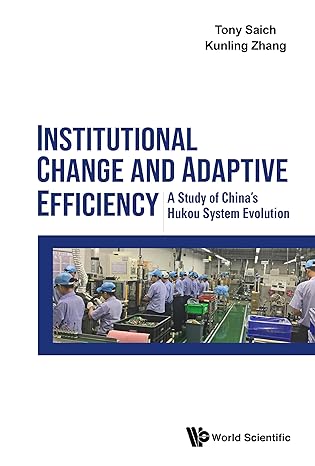
Name: Institutional Change and Adaptive Efficiency: A Study of China's Hukou System Evolution
Author: Tony Saich, Kunling Zhang
Tony Saich is the director of Rajawali Foundation Institute for Asia and Daewoo Professor of International Affairs, teaching courses on comparative political institutions, democratic governance, and transitional economies with a focus on China. In his capacity as the Institute Director, Saich also serves as the Faculty Chair of the China Programs, the Asia Energy Leaders Program, Unseen Legacies of the Vietnam War and the Global Vietnam Wars Studies Initiative.
Saich first visited China as a student in 1976 and continues to visit each year. Currently, he is a guest professor at the School of Public Policy and Management at Tsinghua University, China. He also advises a wide range of government, private and nonprofit organizations on work in China and elsewhere in Asia.
His current research focuses on politics and governance in post-Mao China and philanthropy in China. His most recent books include From Rebel to Ruler: One Hundred Years of the Chinese Communist Party (2021); Finding Allies and Making Revolution: The Early years of the Chinese Communist Party (2020).
Kunling Zhang holds a PhD in Economics from Beijing Normal University. He is now an Assistant Professor of Economics in Belt and Road School at Beijing Normal University, teaching courses to graduate and undergraduate students on public economics. Previously, he was a visiting fellow at the Australian National University (2017–2018) and Harvard Kennedy School (2019–2020). His current research focuses on the fields of development economics, institutional economics and political economy, especially the role of institutional change in economic transformation of developing countries. He has published about 20 academic articles on economics (in both Chinese and English). His most recent project titled Belt and Road Initiative and Industrialization, concerning the role of China's Belt and Road Initiative (BRI) in industrialization in developing countries, will be published soon.
Introduction:
Since the 1990s, neo-institutionalists have posited that 'institutions matter'. However, they overlook one important issue: the ways institutions change also matters. Numerous academic studies have identified 'good' and 'bad' institutions, but little has been written about effective methods of transforming 'bad' institutions so that they enhance economic performance. To fill this gap, this book reframes the approach of neo-institutional economics to analyze institutions' role and evolution, focusing on the interaction between the household registration (hukou) system evolution and economic transformation.
The authors apply an endogenous and dynamic perspective. First, the theory of endogenous institutional change illustrates how the drivers of hukou system evolution differ in the pre-reform and reform eras. Second, the theory of adaptive efficiency evaluates the evolution of the system's institutional efficiency. Finally, the authors were able to test the impact of the hukou reform on urban economic growth by examining local experimentation, helping explain the current 'stickiness' of the system.
At the heart of hukou reform lies the question of how to deal with the link between hukou and welfare provision. This book will offer policymakers a better understanding of institutional change in dynamic economic contexts, helping them enhance economic performance.
-
Beijing · Haidian Campus:No.19 Xinjiekou Wai St, Beijing Normal University Jingshi School 2F, HaiDian District, Beijing, China
-
Zip Code:100875
-
Email:brs@bnu.edu.cn
-
Zhuhai Campus:No.18 Jinfeng Rd, Beijing Normal University Zhuhai Campus Liyun Building, Tangjiawan, Zhuhai City, Guangdong Province, China
-
Zip Code:519085
-
Email:brs@bnu.edu.cn
-
Beijing · Changping Campus:Gaojiaoyuan North 3 St, Changping Capmus Zone G Bldg 1, Changping District, Beijing, China
-
Zip Code:102299
-
Email:brs@bnu.edu.cn

Follow Us
版权所有 © 2022 北京师范大学一带一路学院

