


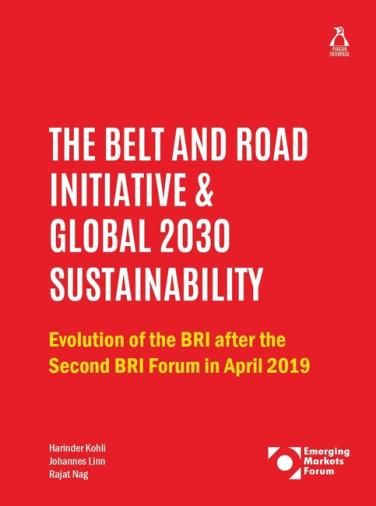
Name: The Belt and Road Initiative & Global 2030 Sustainability
Author: Harinder Kohli , Johannes Linn, Rajat Nag
Harinder Kohli is the Founding Director and Chief Executive of Emerging Markets Forum as well as the Founding Director, President, CEO, and largest shareholder of Centennial Group International, both based in Washington, DC. He has authored and co-authored fifteen books, including Envisioning 2060: Opportunities and Risks for Emerging Markets and China’s Belt and Road Initiative: Potential Transformation of Central Asia and the South Caucasus.
Johannes Linn is a Distinguished Resident Scholar at the Emerging Markets Forum in Washington, DC, and a Nonresident Senior Fellow at the Brookings Institution. He currently serves as the chair for the 10th Replenishment Consultations of the International Fund for Agricultural Development. Linn has published extensively on development and global governance issues, including Central Asia and the Caucasus: At the Crossroads of Eurasia in the 21st Century, Getting to Scale: How to Bring Development Solutions to Millions of Poor People and Financing Metropolitan Governments in Developing Countries.
Rajat Nag is a Distinguished Fellow both at India’s National Council of Applied Economic Research, Delhi and at the Emerging Markets Forum in Washington, DC, and is serving as an Advisor and Board Member for several organizations. He served as the Managing Director General of the Asian Development Bank from 2006-13. Nag was also an editor of the book Envisioning 2060: Opportunities and Risks for Emerging Markets.
Introduction:
This book discusses the progress of the BRI as it enters its tenth year after being launched in 2013 and becoming by far the biggest bilateral development assistance program in the world. The analysis offered herein is based on eleven detailed ‘inside-out’ country studies by independent experts and the studies presented here explain in an accessible manner how the pace and direction of the BRI has been impacted by the pandemic, the debt distress faced by many countries and the policies adopted by the Chinese authorities to navigate these new challenges.
-
Beijing · Haidian Campus:No.19 Xinjiekou Wai St, Beijing Normal University Jingshi School 2F, HaiDian District, Beijing, China
-
Zip Code:100875
-
Email:brs@bnu.edu.cn
-
Zhuhai Campus:No.18 Jinfeng Rd, Beijing Normal University Zhuhai Campus Liyun Building, Tangjiawan, Zhuhai City, Guangdong Province, China
-
Zip Code:519085
-
Email:brs@bnu.edu.cn
-
Beijing · Changping Campus:Gaojiaoyuan North 3 St, Changping Capmus Zone G Bldg 1, Changping District, Beijing, China
-
Zip Code:102299
-
Email:brs@bnu.edu.cn

Follow Us
版权所有 © 2022 北京师范大学一带一路学院

